A Time Travel Echo story
Who was Albert Einstein?
A boy puzzled by a compass grew into a patent clerk who changed how the world understands light, atoms, time and gravity, then spent his last two decades in Princeton.

The boy and the compass
Albert Einstein traced his curiosity about nature to a compass his father showed him at home in Munich in the early 1880s. The moment survives only in his memory. Decades later, he wrote that he was "a child of four or five years" at the time, and that the experience "made a deep and lasting impression upon me. Something deeply hidden had to be behind things" [3].

He was born in Ulm, Germany, on March 14, 1879, to Hermann Einstein and Pauline Koch. The family moved to Munich in 1880 [2], where his father founded an electrical engineering company [1]. His mother, a pianist, started him on the violin at 6 [23].
The family was Jewish but did not practice the religion. Einstein later called his parents "entirely irreligious" [3][4]. In Munich he attended a Catholic primary school and took private lessons in Judaism. He grew deeply religious, until the phase ended abruptly at 12 [50].
The outsider
He was outstanding in mathematics, but he hated Munich's academic high school, where success depended on memorization and obedience [4]. At 15, on Dec. 29, 1894, he withdrew and took the train to Milan to join his family, who had moved to Italy [4][27].
In October 1895, two years under the usual age, he sat the entrance exam for the Federal Polytechnic in Zurich [27]. He failed, but not because of math: mathematics and science were his best results. He finished school in Aarau, Switzerland [5].
In Aarau, at 16, he imagined chasing a beam of light. If he could keep pace with it, he reasoned, he would see the wave frozen in place. Neither experience nor the laws of electricity and magnetism allowed that. He later called it his first childlike thought experiment connected with special relativity [27][54].
At the Polytechnic, from 1896 to 1900, he trained to teach mathematics and science [6]. Mileva Marić, the only woman registered in his department, would become his wife [36]. His friend Marcel Grossmann shared careful lecture notes. "I would rather not speculate on what would have become of me without these notes," Einstein later wrote [28]. After graduating, he scraped by as a tutor [6]. He became a Swiss citizen in 1901 [2].

On June 23, 1902, he started at the patent office in Bern as a technical expert, class III [7]. He married Mileva in 1903, and their son Hans Albert was born in 1904 [2]. He later called the office "that worldly cloister where I hatched my most beautiful ideas" [8].
The miracle year, 1905
In 1905, the 26-year-old clerk sent the journal Annalen der Physik four landmark papers [9].
Light comes in packets. Physicists thought of light as a smooth wave. Einstein argued that it can also act like a stream of separate bits of energy, called light quanta, going far beyond an idea of Max Planck's [29]. It explained the photoelectric effect: how light knocks electrons out of metal [29].
Atoms are real. Many scientists still doubted that. Einstein showed that tiny specks floating in a liquid should jitter as unseen molecules strike them unevenly. That explained Brownian motion, a long-observed puzzle [29]. Jean Perrin's experiments soon confirmed his analysis and helped win over the skeptics [40][47].
Time is not fixed. Experiments run the same way in a lab at rest or one moving steadily. Galileo made the point in 1632: below decks on a smoothly sailing ship, falling drops land just as they would if the ship stood still [49]. Einstein made that principle of relativity a law for all of physics, including light, and added a second one: light in empty space always travels at the same speed, however fast its source is moving. He made the two fit by rethinking time itself, in what became special relativity [29][39]. As a result, a moving clock ticks more slowly [43]. The paper thanked the engineer Michele Besso, "my friend and colleague," for "several valuable suggestions" [28][39].
He later explained one result with a thought experiment in his 1916 popular book on relativity. Lightning strikes the track at two points as a long train speeds by. Someone on the embankment, midway between the strikes, sees both flashes at once. A passenger at the train's midpoint is moving toward one flash and away from the other, so light from the strike ahead reaches the passenger first. For the passenger, the strikes did not happen at the same time. "Every reference-body (co-ordinate system) has its own particular time," he wrote [55].
Mass is energy. A short follow-up showed that when a body gives off energy, its mass drops by a matching amount [29]. That is E=mc². E is energy, m is mass, and c² is the speed of light multiplied by itself, a huge number [30]. So a little mass holds an enormous amount of energy, as nuclear physicists confirmed in the 1930s [35].
Bent starlight and fame, 1919
He left the patent office in 1909 for a professorship at the University of Zurich [7]. Next, Einstein took on gravity.
In 1907, still at the patent office, he had what he called "the happiest thought of my life." For an observer falling freely from the roof of a house, he wrote, there is no gravitational field, at least in his immediate vicinity. Anything the observer lets go of stays at rest or moves steadily beside him [56][57]. That idea, the equivalence principle, set him on the road to general relativity [56].
To build a theory of gravity, he needed new mathematics, and Grossmann pointed him to tensor calculus [37]. In 1913, Planck and Walther Nernst invited him to Berlin [38]. He moved there in 1914 and separated from Mileva and their two sons [2].
On Nov. 25, 1915, he submitted the field equations of general relativity, a law of gravity that superseded Newton's [10]. In his theory, matter warps space and time, and that warping guides how objects move [11][31]. A bowling ball denting a trampoline, so that a rolling marble curves toward it, gives a rough picture, though the real warping is in four dimensions and includes time [11][48]. The theory predicted that the sun's gravity would bend starlight [32].

Astronomer Royal Frank Dyson organized two British teams to test the prediction during the total solar eclipse of May 29, 1919. One went to Sobral, Brazil, and Arthur Eddington's to Príncipe, off West Africa, where the day began with a heavy thunderstorm and cleared just before totality. Eddington wrote to his mother that "the one good plate that I measured gave a result agreeing with Einstein" [12]. The Royal Society and the Royal Astronomical Society announced the results at a joint meeting on Nov. 6 [12]. Einstein became the world's symbol of the new physics [33], and in 1921 the Royal Society made him a Foreign Member [14]. In 1919 he also divorced Mileva and married his cousin Elsa [2].
Fame also made him a target for antisemites. On Aug. 24, 1920, Paul Weyland, a right-wing publicist, staged an anti-relativity rally at the Berlin Philharmonic, where speakers denounced Einstein as a fraud. Einstein attended. One Berlin newspaper reported antisemitic pamphlets at the rally, and another reported swastika lapel pins on sale [51]. In the 1920s, Nobel laureate Philipp Lenard's attacks on Einstein turned openly racial [52]. In the 1930s, Lenard and fellow laureate Johannes Stark led the "Deutsche Physik" ("German physics") movement, which called for an "Aryan" physics and attacked relativity as "Jewish" [34][52][53].
The Nobel Prize and the Gothenburg lecture
The prize singled out his work on light, not relativity. The Royal Swedish Academy of Sciences held over the 1921 physics prize and announced it on Nov. 9, 1922 [41]. It went to Einstein "for his services to Theoretical Physics, and especially for his discovery of the law of the photoelectric effect" [1]. Some influential Swedish Academy members still doubted relativity [25][45]. He was on a ship to Japan when the news came and missed the Stockholm ceremony [25][41].

He gave his Nobel lecture the next summer, on July 11, 1923, to the Nordic Assembly of Naturalists at Gothenburg, Sweden [24]. More than 1,000 people filled the Congress Hall of the city's jubilee exhibition despite the stifling heat, with King Gustaf V in the front row [25][26]. Einstein spoke in German about relativity, not the photoelectric effect, gesturing toward the vaulted ceiling as he explained coordinate systems [25]. Afterward, the king came forward and shook his hand [26].
Exile and Princeton
Fame did not protect Einstein from the Nazis. They attacked him as a Jew and an opponent of their regime [16]. When Hitler became chancellor on Jan. 30, 1933, Einstein was teaching at Caltech. The Gestapo raided his family's Berlin apartment, and Nazis ransacked his summer cottage [16]. Nazi extremists reportedly put a price on his head [6][46]. On March 28, he turned in his German passport at the consulate in Brussels [16]. Germany seized the property he left behind [16]. In April, a new law barred Jews and political opponents like him from civil service posts, including university jobs. It drove out 14 Nobel laureates and 26 of the country's 60 professors of theoretical physics [16].
He arrived in Princeton, New Jersey, in October 1933 to join the Institute for Advanced Study [17]. After two years at 2 Library Place [13], he bought 112 Mercer Street in 1935 [17]. Elsa died in 1936 [34]. His stepdaughter Margot, his secretary Helen Dukas and his sister, Maja, shared the house [13].

He played the violin most of his life, and Mozart stayed his favorite [23]. In 1939, fearing that Nazi Germany might build atomic bombs, he signed a letter warning President Franklin D. Roosevelt. He played no other role in the bomb project [35]. He became a U.S. citizen in 1940 [2] and died in Princeton on April 18, 1955 [1].
What he left us
His ideas now work inside everyday technology. Solar cells and digital camera sensors rely on the photoelectric effect he explained, turning light into electric signals [41][42].
GPS satellite clocks run fast by a net 38 microseconds a day, because their speed slows them and the weaker gravity of their orbits speeds them up. Uncorrected, position errors would grow by about 10 kilometers a day [43].
On Sept. 14, 2015, LIGO detected gravitational waves, ripples in spacetime, from two black holes that merged 1.3 billion years ago. The detection, announced on Feb. 11, 2016, confirmed a major prediction of his theory. In the collision, about three times the mass of the sun became wave energy, as E=mc² describes [44].
Many quotes credited to him aren't his. "The Ultimate Quotable Einstein" has a whole section of sayings probably not by Einstein [18][19].
4 things you didn't know about Einstein
- He co-invented a refrigerator. Einstein and physicist Leo Szilard received U.S. Patent 1,781,541, "Refrigeration," on Nov. 11, 1930 [20].
- He turned down the presidency of Israel. In November 1952, Ambassador Abba Eban asked him, on Prime Minister David Ben-Gurion's behalf, whether he would accept the post [22]. Einstein told Ben-Gurion that he could not [21].
- He gave up his German citizenship twice. He renounced it first as a teenager in 1896 and became a Swiss citizen in 1901 [2]. After taking German citizenship back while working in Berlin [15], he renounced it again on March 28, 1933 [16].
- His violin had a name. He reportedly called each of his violins "Lina," and Mozart's sonatas were among his favorites [23].
From The Time Traveler's original series on X
The Time Traveler first told this story on X on May 5, 2023, a day after a teaser, in the original series that brought history's great lives back with SI images. A video feature revisited it on July 3, 2023.

About the images
The Time Traveler made every image on this page with Super Intelligence (SI) tools. They are illustrations, not photographs. Each one shows a documented moment or idea, but the illustration imagines the details. The notes below separate what the record shows from what each image adds.
- Princeton, about 1947
- Documented: Einstein arrived in Princeton in October 1933 to join the Institute for Advanced Study [17]. He lived at 2 Library Place for two years, then at 112 Mercer Street from 1935 until his death in 1955 [13][17]. He smoked a pipe, and one survives at the Historical Society of Princeton [13].
- Imagined: The room, the pose and the pen. The cardigan and hair are likeness details from period photos, not documented claims.
- The compass, as he remembered it
- Documented: In his "Autobiographical Notes," Einstein recalled that when he was 4 or 5, his father showed him a compass [3].
- Imagined: The scene itself, drawn from his later memory. The image does not name the boy.
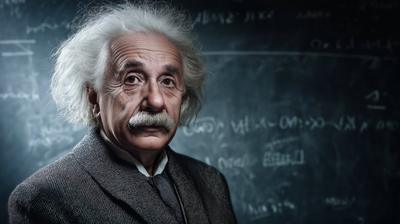
- The Bern patent clerk, 1905
- Documented: Einstein started work at the federal patent office in Bern on June 23, 1902, and left it in 1909 [7]. In 1905 he sent Annalen der Physik four landmark papers [9].
- Imagined: The exact room layout, the inkwell and pen, the chair and the moment.
- Spacetime, the idea itself
- Documented: In general relativity, gravity is the curvature of spacetime, which matter can stretch and warp [11]. During the 1919 solar eclipse, the best measurements, taken at Sobral in Brazil, closely followed Einstein's prediction that the sun's gravity bends starlight [12].
- Imagined: This is a teaching illustration, not a picture of what spacetime literally looks like.
- The Nobel lecture, Gothenburg, July 11, 1923
- Documented: Einstein gave his Nobel lecture, "Fundamental ideas and problems of the theory of relativity," on July 11, 1923, to the Nordic Assembly of Naturalists at Gothenburg [24], in the Congress Hall of the Gothenburg Jubilee Exhibition [25][26]. The lecture covered relativity, not the photoelectric effect [24].
- Imagined: The camera position, the exact pose and lighting, the audience's faces and clothing, and the hall's architecture (arched windows, chandeliers, plants). The illustration invents the audience; no figure in it depicts King Gustaf V, the governor or any other real person.
- Einstein's violin
- Documented: Einstein played the violin for most of his life and loved Mozart [23].
- Imagined: The specific room and moment. The cardigan and white hair are likeness details from later photos.
- The original series images
- Imagined: All of it. These stylized images from 2023 and 2025 make no claim about how Einstein or his surroundings looked.
Sources
Sources last checked Oct. 18, 2026.
- Nobel Prize Outreach. "Albert Einstein – Facts." NobelPrize.org. Accessed Oct. 17, 2026. https://www.nobelprize.org/prizes/physics/1921/einstein/facts/
- American Institute of Physics, Center for History of Physics. "An Albert Einstein Chronology." A. Einstein: Image and Impact (online exhibit, 1996–2004). https://history.aip.org/exhibits/einstein/chron.htm
- Einstein, Albert. "Autobiographical Notes," translated by Paul Arthur Schilpp. Excerpted from Hanoch Gutfreund and Jürgen Renn, "Einstein on Einstein" (Princeton University Press, 2020), via Literary Hub, May 14, 2020. https://lithub.com/something-like-my-own-obituary-albert-einstein-on-skepticism-reason-and-truth/
- American Institute of Physics, Center for History of Physics. "Formative Years I." A. Einstein: Image and Impact. https://history.aip.org/exhibits/einstein/early1.htm
- ETH Library, ETH Zurich. "Einstein's youth (1879–1896)." Einstein Online. https://library.ethz.ch/en/collections-and-archives/platforms/einstein-online/jugend-1879-1896.html
- ETH Library, ETH Zurich. "Albert Einstein (1879–1955)." Short portraits. https://library.ethz.ch/en/collections-and-archives/short-portraits/einstein-albert-1879-1955.html
- Swiss Federal Institute of Intellectual Property. "Einstein: FAQ." https://www.ige.ch/en/about-us/the-history-of-the-ipi/einstein/faq
- Swiss Federal Institute of Intellectual Property. "Einstein at the patent office." https://www.ige.ch/en/about-us/the-history-of-the-ipi/einstein/einstein-at-the-patent-office
- American Institute of Physics, Center for History of Physics. "Einstein Chronology for 1905." https://history.aip.org/exhibits/einstein/chron-1905.htm
- Einstein Papers Project, Caltech. "One Hundred Years of Einstein's Field Equations, and of the Explanation of Mercury's Perihelion." Nov. 25, 2015. https://www.einstein.caltech.edu/news/one-hundred-years-of-einsteins-field-equations-and-of-the-explanation-of-mercurys-perihelion
- Gravity Probe B, Stanford University. "Einstein's Spacetime." https://einstein.stanford.edu/SPACETIME/spacetime2.html
- Catchpole, Robin, and Graham Dolan. "General Relativity and the 1919 Solar Eclipse." Royal Observatory Greenwich. https://www.royalobservatorygreenwich.org/articles.php?article=1283
- Historical Society of Princeton. "Albert Einstein." Historic Princeton. https://princetonhistory.org/research/historic-princeton/albert-einstein/
- Milovanovic, Vida. "Friends reunited." Royal Society blog, May 29, 2024. https://royalsociety.org/blog/2024/05/friends-reunited/
- American Institute of Physics, Center for History of Physics. "Public Concerns." A. Einstein: Image and Impact. https://history.aip.org/exhibits/einstein/public1.htm
- United States Holocaust Memorial Museum. "Albert Einstein Quits Germany, Renounces Citizenship" (event of March 28, 1933). History Unfolded. https://newspapers.ushmm.org/events/albert-einstein-quits-germany-renounces-citizenship
- Institute for Advanced Study. "Albert Einstein's House: 112 Mercer Street, Princeton." https://www.ias.edu/albert-einsteins-house-112-mercer-street-princeton
- Calaprice, Alice, ed. "The Ultimate Quotable Einstein." Princeton University Press, 2010 (copyright 2011). https://press.princeton.edu/books/hardcover/9780691138176/the-ultimate-quotable-einstein
- Quote Investigator. "Quote Origin: It's Not That I'm So Smart, It's Just That I Stay With Problems Longer." Oct. 3, 2024. (Cites the book's section "Probably Not by Einstein.") https://quoteinvestigator.com/2024/10/03/smart-stay/
- Einstein, Albert, and Leo Szilard. U.S. Patent 1,781,541, "Refrigeration," granted Nov. 11, 1930. Google Patents. https://patents.google.com/patent/US1781541A/en
- The New York Times. "Einstein Declines Israeli Presidency." Nov. 19, 1952, page 1. https://www.nytimes.com/1952/11/19/archives/einstein-declines-israeli-presidency-einstein-declines-israel.html
- Jewish Virtual Library. "Offering the Presidency of Israel to Albert Einstein" (Abba Eban's letter of Nov. 17, 1952, and Einstein's reply; from the Albert Einstein Archives, Hebrew University). https://www.jewishvirtuallibrary.org/offering-the-presidency-of-israel-to-albert-einstein
- Waldrop, Mitch. "Inside Einstein's Love Affair With 'Lina'—His Cherished Violin." National Geographic, Feb. 3, 2017. https://www.nationalgeographic.com/adventure/article/einstein-genius-violin-music-physics-science
- Nobel Prize Outreach. "Albert Einstein – Nobel Lecture: Fundamental ideas and problems of the theory of relativity" (lecture delivered to the Nordic Assembly of Naturalists at Gothenburg, July 11, 1923). NobelPrize.org. https://www.nobelprize.org/prizes/physics/1921/einstein/lecture/
- Bucchi, Massimiano. "The Public Uses of Scientific Celebrity: Einstein's Visits to Italy, Japan and Sweden, 1921–1923." Minerva, published online April 1, 2026 (peer-reviewed, open access). https://doi.org/10.1007/s11024-026-09637-y
- Göteborgs historia. "Prof. Einstein i Kongresshallens talarestol." July 12, 2021 (quotes Göteborgs Aftonblad, July 12, 1923, and the Göteborgs stadsmuseum photo caption). https://goteborgshistoria.com/2021/07/12/prof-einstein-i-kongresshallens-talarestol/
- Stachel, John, David C. Cassidy and Robert Schulmann, eds. "The Collected Papers of Albert Einstein, Vol. 1: The Early Years, 1879–1902." Princeton University Press. Chronology, p. 372. Archived digital edition: https://web.archive.org/web/2015/http://einsteinpapers.press.princeton.edu/vol1-doc/440
- American Institute of Physics, Center for History of Physics. "Formative Years II." A. Einstein: Image and Impact. https://history.aip.org/exhibits/einstein/early2.htm
- American Institute of Physics, Center for History of Physics. "The Great Works." A. Einstein: Image and Impact. https://history.aip.org/exhibits/einstein/great1.htm
- American Institute of Physics, Center for History of Physics. "E=mc²." A. Einstein: Image and Impact. https://history.aip.org/exhibits/einstein/emc1.htm
- American Institute of Physics, Center for History of Physics. "The Great Works II." A. Einstein: Image and Impact. https://history.aip.org/exhibits/einstein/great2.htm
- American Institute of Physics, Center for History of Physics. "World Fame I." A. Einstein: Image and Impact. https://history.aip.org/exhibits/einstein/fame1.htm
- American Institute of Physics, Center for History of Physics. "World Fame II." A. Einstein: Image and Impact. https://history.aip.org/exhibits/einstein/fame2.htm
- American Institute of Physics, Center for History of Physics. "Public Concerns II." A. Einstein: Image and Impact. https://history.aip.org/exhibits/einstein/public2.htm
- American Institute of Physics, Center for History of Physics. "The Nuclear Age." A. Einstein: Image and Impact. https://history.aip.org/exhibits/einstein/nuclear1.htm
- ETH Library, ETH Zurich. "Einstein's Studies at the Polytechnic Institute in Zurich (1896–1900)." Einstein Online. https://library.ethz.ch/en/collections-and-archives/platforms/einstein-online/studium-am-polytechnikum-in-zuerich-1896-1900.html
- O'Connor, J. J., and E. F. Robertson. "Marcel Grossmann (1878–1936)." MacTutor History of Mathematics, University of St Andrews. https://mathshistory.st-andrews.ac.uk/Biographies/Grossmann/
- Max Planck Society. "Albert Einstein in the attic." https://www.mpg.de/9695595/einstein-in-berlin
- Einstein, Albert. "On the Electrodynamics of Moving Bodies" (1905), English translation by W. Perrett and G. B. Jeffery in "The Principle of Relativity" (Methuen, 1923). Fourmilab edition. https://www.fourmilab.ch/etexts/einstein/specrel/www/
- Renn, Jürgen. "Einstein's invention of Brownian motion." Annalen der Physik 14, Supplement (2005): 23–37. https://doi.org/10.1002/andp.200410131
- Nobel Prize Outreach. "Albert Einstein – Questions and answers." NobelPrize.org. https://www.nobelprize.org/prizes/physics/1921/einstein/questions-and-answers/
- Royal Swedish Academy of Sciences. "The Nobel Prize in Physics 2009" (press release, Oct. 6, 2009). NobelPrize.org. https://www.nobelprize.org/prizes/physics/2009/press-release/
- Pogge, Richard W. "Real-World Relativity: The GPS Navigation System." Department of Astronomy, Ohio State University. https://www.astronomy.ohio-state.edu/pogge.1/Ast162/Unit5/gps.html
- LIGO Laboratory, Caltech. "Gravitational Waves Detected 100 Years After Einstein's Prediction." News release, Feb. 11, 2016. https://www.ligo.caltech.edu/news/ligo20160211
- Nobel Prize Outreach. "The dual nature of light as reflected in the Nobel archives." NobelPrize.org. https://www.nobelprize.org/prizes/themes/the-dual-nature-of-light-as-reflected-in-the-nobel-archives/
- United States Holocaust Memorial Museum. "Report Nazis Put Price On Prof. Einstein's Head" (AP, Brussels, Sept. 7, 1933, in the Chambersburg Public Opinion). History Unfolded. https://newspapers.ushmm.org/historical-article/1933-report-nazis-put-price-on-prof-einsteins-head-29459
- Nobel Prize Outreach. "Jean Baptiste Perrin – Facts." NobelPrize.org. https://www.nobelprize.org/prizes/physics/1926/perrin/facts/
- Foyle, Kelly, and Philip Freeman. "General Relativity: Beyond the Bowling Ball and the Trampoline." OAPT Newsletter (Ontario Association of Physics Teachers), Nov. 23, 2020. http://newsletter.oapt.ca/files/general-relativiy-analogies.html
- Galilei, Galileo. "Dialogue Concerning the Two Chief World Systems" (1632), Second Day, translated by Stillman Drake (University of California Press, 1953), pp. 186–187. Excerpt via York University. https://www.yorku.ca/menary/courses/phys1000/galquote.pdf
- Stachel, John, David C. Cassidy and Robert Schulmann, eds. "The Collected Papers of Albert Einstein, Vol. 1: The Early Years, 1879–1902." Princeton University Press. Chronology, p. 370 (entry for ca. Oct. 1, 1885: Petersschule, Catholic primary school; private Jewish religious instruction; religiosity that ended at age 12). Archived digital edition: https://web.archive.org/web/2015/http://einsteinpapers.press.princeton.edu/vol1-doc/438
- van Dongen, Jeroen. "Reactionaries and Einstein's Fame: 'German Scientists for the Preservation of Pure Science,' Relativity, and the Bad Nauheim Meeting." Physics in Perspective 9 (2007): 212–230. https://doi.org/10.1007/s00016-006-0318-y (preprint: https://arxiv.org/abs/1111.2194)
- Ball, Philip. "Einstein and Nazi physics: When science meets ideology and prejudice." Mètode Science Studies Journal 10 (2020): 147–155. https://doi.org/10.7203/metode.10.13472
- German Historical Institute, Washington. "Philipp Lenard, Excerpt from German Physics (1936/37)." German History in Documents and Images. https://germanhistorydocs.org/en/nazi-germany-1933-1945/philipp-lenard-excerpt-from-german-physics-1936-37
- Norton, John D. "Chasing a Beam of Light: Einstein's Most Famous Thought Experiment." Department of History and Philosophy of Science, University of Pittsburgh (quotes Einstein's "Autobiographical Notes"). https://sites.pitt.edu/~jdnorton/Goodies/Chasing_the_light/index.html
- Einstein, Albert. "Relativity: The Special and General Theory" (first published December 1916), authorised translation by Robert W. Lawson (Methuen). Section IX, "The Relativity of Simultaneity." Project Gutenberg eBook #30155. https://www.gutenberg.org/ebooks/30155
- Janssen, Michel. "The twins and the bucket: How Einstein made gravity rather than motion relative in general relativity." Studies in History and Philosophy of Modern Physics 43 (2012): 159–175 (quotes and translates Einstein's unpublished 1920 manuscript "Fundamental Ideas and Methods of the Theory of Relativity, Presented in Their Development," Collected Papers Vol. 7, Doc. 31). https://doi.org/10.1016/j.shpsb.2012.01.003 (preprint: https://philsci-archive.pitt.edu/8605/)
- Einstein, Albert. "Fundamental Ideas and Methods of the Theory of Relativity, Presented in Their Development" (1920), Doc. 31 in The Collected Papers of Albert Einstein, Vol. 7: The Berlin Years: Writings, 1918–1921 (English translation supplement, trans. Alfred Engel), Princeton University Press, p. 136. Archived digital edition. https://web.archive.org/web/20160826055753/http://einsteinpapers.press.princeton.edu/vol7-trans/152